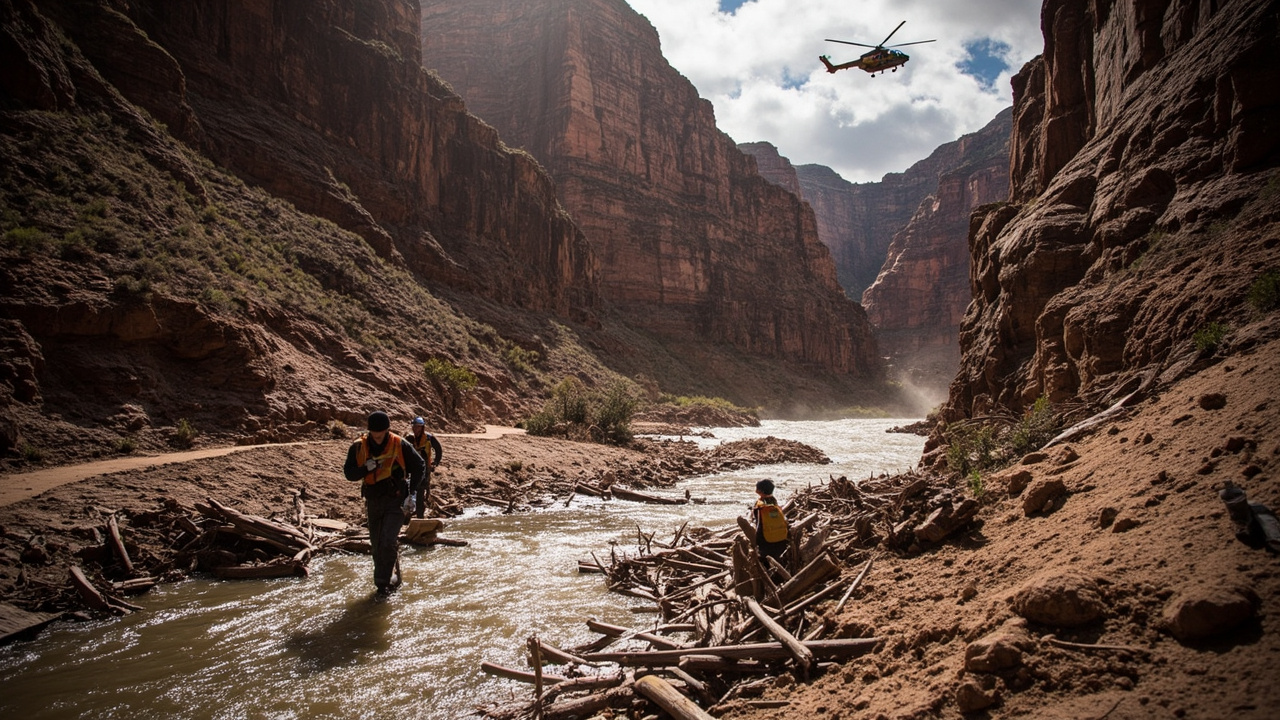
TL;DR: One week after the August 29 flash flood in Bright Angel Canyon and Phantom Ranch, one hiker remains missing, inner-canyon closures remain in effect, and Grand Canyon National Park is building a temporary water intake designed to restore South Rim supply in weeks, not months.
A week after the August 29 flood
Grand Canyon National Park continues response and recovery operations following the significant August 29 flash flood in Bright Angel Canyon and the Phantom Ranch area, according to the National Park Service release titled "Grand Canyon National Park Announces Recovery and Repair Plan Following Flash Flood."
That September 8 update describes three parallel missions: active search operations, infrastructure assessments and stabilization work, and efforts to restore a reliable water supply to the South Rim.
A second September 8 report, the KNAU STAFF report titled "Search for missing hiker, damage assessments continue one week after Grand Canyon flash flood," frames the same moment as the start of a long recovery, with crews still searching the canyon and along the Colorado River while engineers assess damaged infrastructure and services.
For wilderness travelers, the central readiness point is that the inner canyon around Phantom Ranch is not back to normal. The park states that visitors should expect modified operations and closures in affected inner-canyon areas and should check current park conditions before traveling.
The park remains open on both the South Rim and North Rim, but inner-canyon access is restricted. Visitors to the South Rim are encouraged to arrive prepared with drinking water and to conserve water throughout their visit.
The missing hiker and the ongoing search
Search operations remain active more than a week after the flood. One person remains missing and unaccounted for, the National Park Service says.
Search teams continue working in the delta area near Phantom Ranch, while river patrol crews are searching downstream along the Colorado River and adjacent areas where flood debris may have been carried.
The missing hiker is Timothy Allen Smith, 53, who was hiking with two other people when flooding hit Bright Angel Canyon and the Phantom Ranch area on August 29, according to the KNAU STAFF report titled "Search for missing hiker, damage assessments continue one week after Grand Canyon flash flood."
Teams recovered the bodies of John Giusti, 46, and Brent Rosenkranz, 42, in the following days. Both men were from Granbury, Texas, the same KNAU report states.
Smith was still missing more than a week later. The National Park Service says crews continue to search the canyon and along the Colorado River.
The National Park Service and its partners remain committed to the search while response, repair and longer-term recovery work continues throughout the affected area, according to the September 8 National Park Service recovery update.
The park says it will continue providing updates as work progresses.
What is closed in the inner canyon
Several trails, campgrounds and bridges remain closed, according to KNAU.
The September 8 National Park Service update asks visitors to expect modified operations and closures in affected inner-canyon areas. Those closures support damage assessment, stabilization and repair, and they keep visitors out of hazardous ground where trails, bridges, utilities and other infrastructure were damaged or destroyed.
The practical lesson for route planning is direct: do not plan an inner-canyon itinerary through Bright Angel Canyon, Phantom Ranch, or the associated campgrounds and river crossings without first confirming the current closure map and park alerts.
Commercial and non-commercial river operations, backcountry camping, and rim-to-rim route choices can change quickly during flood recovery. Checking current park conditions before traveling is the step the park specifically requests.
Visitors should also understand that conditions on the ground, not a calendar date, will drive reopening decisions. That means flexibility, backup routes above the rim, and willingness to cancel an inner-canyon descent are part of readiness while recovery continues.
How the flood broke the South Rim water system
Flood damage to the Transcanyon Waterline has cut off water service to the South Rim, KNAU reports, with hotels on the South Rim still closed to overnight guests and Stage 4 water restrictions in effect.
The September 8 National Park Service release provides the engineering detail behind that outage. The August 29 flood caused extensive damage to the legacy Transcanyon Waterline, including approximately 40% of the old pipeline between the Phantom Ranch area and the North Rim.
The Bright Angel Creek and Roaring Springs intake areas also sustained significant damage.
Importantly, the new pipeline infrastructure on the south side of the canyon was not damaged by the flood, the park says. Prior to the flood, the park was just over a month away from beginning operation of the new system.
The park is now accelerating work that was already underway to bring that infrastructure into service.
For backcountry and front-country readiness, the message is that water in the canyon and on the South Rim cannot be treated as guaranteed. Floods can destroy intakes, expose or break pipeline sections, contaminate sources with debris and sediment, and force managers to isolate parts of a system to protect water quality.
That is why the park is asking residents, employees, visitors, businesses and partners to continue conserving, and why it encourages South Rim visitors to arrive prepared with drinking water.
The temporary intake plan: 500 gallons per minute
The park now has a path forward to restore water service and, based on current progress, expects that work to take weeks, not months, according to the National Park Service.
Crews are moving forward with construction of a temporary water intake at Bright Angel Creek to replace the intake destroyed by the flood.
Engineers are in the canyon designing the temporary intake, the existing Transcanyon Waterline contract has been modified to support the work, and construction activities are beginning this week.
The temporary intake is being designed to pump approximately 500 gallons per minute, the same capacity available before the flood. Once operational, it will allow water to move through the new Transcanyon Waterline system and begin replenishing South Rim storage while work on a permanent intake continues.
Electrical service necessary to support work on the temporary intake system has been restored, debris removal is underway, and crews continue preparing the site for construction.
Testing and commissioning work is being accelerated at the new South Rim water treatment plant. The National Park Service is working closely with the Arizona Department of Environmental Quality to meet applicable requirements and bring the plant online safely and as quickly as possible.
The park is also evaluating responsible options for supplementing the water supply. Any water introduced into the existing system must meet specific water-quality and chemical compatibility requirements to avoid damaging the distribution and treatment systems.
The National Park Service is working with the Arizona Department of Environmental Quality, contractors and potential suppliers to evaluate those options.
Stored water, conservation math, and South Rim operations
While repairs move forward, water conservation remains critical. The South Rim continues to rely on stored water.
During the latest operational period, stored water declined approximately 0.37 feet, compared with approximately 0.7 feet per day under normal operating conditions, according to the September 8 National Park Service update.
Current conservation measures are offsetting approximately 137,000 gallons of potable water use each day, extending the amount of time available for crews to complete critical work on the water system.
KNAU, citing a Monday update, reported a slightly earlier conservation figure: conservation efforts had offset approximately 105,000 gallons of potable water per day, with usage down to about half the rate of a normal day. The difference reflects successive operational updates during a fast-moving conservation effort, with the September 8 National Park Service figure representing the latest reported daily offset.
The park says every gallon saved gives crews additional time and flexibility to complete the temporary intake and restore the system.
Teams are also actively monitoring the distribution system for leaks and unusual water use. Some leaks can be addressed immediately, while others require a more careful calculation.
Certain repairs require the affected portion of the water system to be flushed before it can safely return to service. In some cases, flushing would consume more water than the leak is currently losing. Crews are evaluating each situation individually to determine which action will conserve the greatest amount of water overall.
To further reduce demand on the South Rim system, potable-water tanks, bottled drinking water, handwashing stations, portable showers, laundry facilities and portable toilets are being deployed throughout the community.
Five 2,500-gallon potable-water tanks have already been placed, with additional tanks planned. More than 13,500 gallons of potable drinking water has also been staged throughout the South Rim.
South Rim tap water remains safe to use, and there is no boil-water advisory in effect, the park says.
The National Park Service will host a community meeting at 5 p.m. Tuesday at the Shrine of the Ages as well as online, according to KNAU, giving residents, workers and visitors another direct briefing on search, water and closure status.
Sources referenced
- Grand Canyon National Park Announces Recovery and Repair Plan Following Flash Flood - Grand Canyon National Park (U.S. National Park Service) (https://www.nps.gov/grca/learn/news/grand-canyon-national-park-announces-recovery-and-repair-plan-following-flash-flood.htm)
- Search for missing hiker, damage assessments continue one week after Grand Canyon flash flood - KNAU Arizona Public Radio (https://www.knau.org/knau-and-arizona-news/2026-09-08/search-for-missing-hiker-damage-assessments-continue-one-week-after-grand-canyon-flash-flood)