TL;DR: 70-year-old Craig Berg survived 11 days lost on Isle Royale after losing his phone in a swamp on day four of a solo hike, and was rescued Sept. 12 at Intermediate Lake after kayakers heard him yelling for help.
Craig Berg of Royal Oak, Michigan, walked out of the Lake Superior backcountry alive after almost two weeks alone. The 70-year-old had planned a seven-day solo hike in Isle Royale National Park and went missing after a wrong turn on day four left him in waist-deep mud without his phone for navigation, according to My UP Now. He rationed freeze-dried meals, drank brown swamp water he dug out with hiking sticks, sheltered in wet clothing and later in his tent, and used the sun, a headlamp signal, and an MP3-player radio to keep moving and keep hope. On Sept. 12, his 11th day lost, two Michigan National Guard veteran kayakers at Intermediate Lake heard his cries, paddled to him, and summoned park officials, leading to a U.S. Coast Guard helicopter hoist to a hospital in Marquette, Michigan, where he was treated for dehydration and hypothermia, according to Paddling Magazine.
Who Was Lost And Where The Trip Went Wrong
Berg, described by Sudbury News as a Detroit-area, recently retired engineer and experienced hiker, set out for a week-long solo trek on Isle Royale, a remote island in Lake Superior. The park island is roughly 45 miles long and about 9 miles wide, according to Paddling Magazine.
Four days into the planned seven-day hike, Berg left the marked route and dropped into a swamp, according to Sudbury News. My UP Now reported the wrong turn involved a poorly marked trail and left him trapped in waist-deep mud in freezing temperatures.
Berg waded through thick mud for hours and fell more times than he could count, according to Paddling Magazine. Sudbury News reported he struggled for six or seven hours through wet, muddy terrain to regain solid ground. Somewhere in that effort he lost the phone he had been using to navigate. My UP Now reported he dropped his phone in the swamp.
With gear and clothing soaked, Berg found a small elevated patch of dry ground and spent the night there, according to Paddling Magazine. Sudbury News reported there was no room to pitch his tent that first night, so he sheltered only in a sleeping bag while wearing wet clothing. He woke fatigued and dehydrated.
Berg later recalled shivering through that night and wondering whether fear or cold made his teeth chatter, according to Paddling Magazine. Sudbury News quoted his assessment that the first dark, cold night was probably the lowest point. By morning he decided he had to climb toward higher ground or he would die in the low wetland.
Why He Did Not Wait For Rescue In One Place
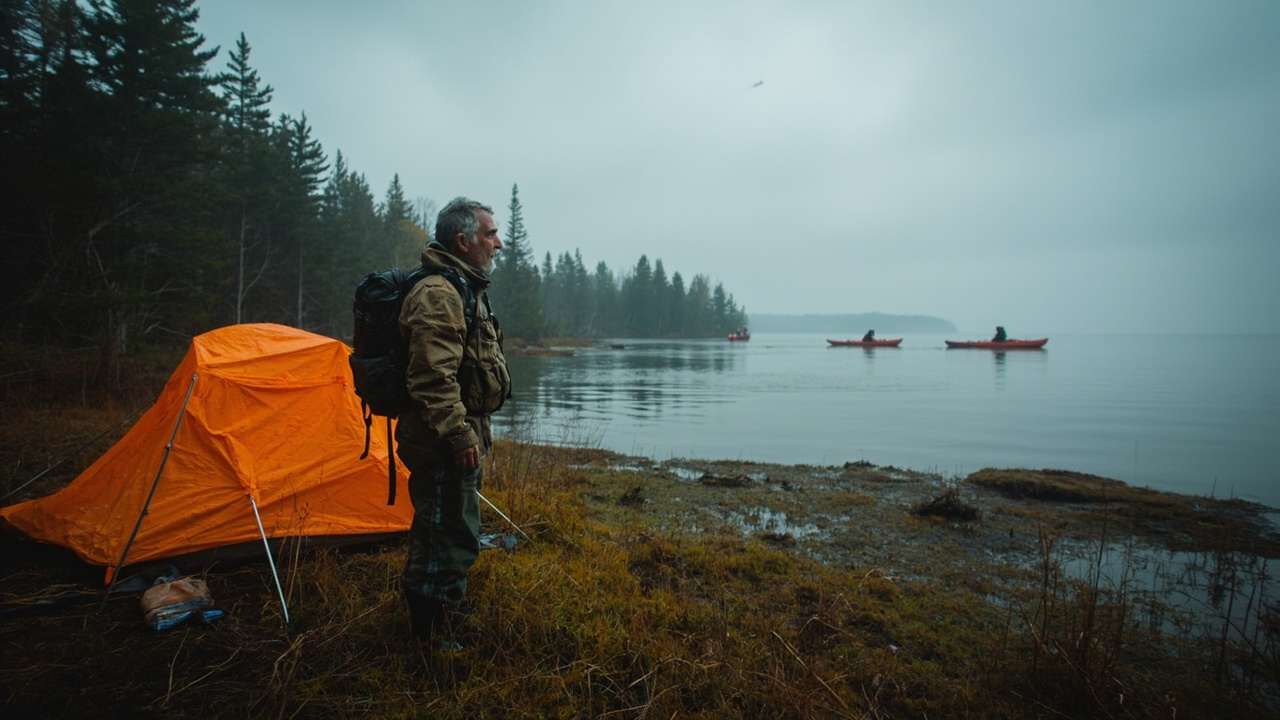
Berg initially tried to stay visible. He worked his way out of the swamp, set up his tent, and hoped search aircraft would spot his orange shelter from above, according to Paddling Magazine. He stayed in the same spot for two days, drying gear and waiting.
A safety talk from the ferry ride stayed with him. Berg recalled that a ranger during orientation warned that help after an injury or mishap could take several days to arrive, according to Paddling Magazine. That warning pushed him to act rather than remain in camp indefinitely.
He then chose a travel direction and kept to it, using the sun to guide him toward what he hoped was the south shore of the island, according to Paddling Magazine. The forest was dense enough that he often had to remove his pack, lift it over fallen logs, and climb through, according to Sudbury News.
At night he shined his headlamp when aircraft passed overhead, attempting to signal, according to Paddling Magazine. Rain forced repeated stops to dry clothing and equipment, according to Sudbury News.
How Food, Water And Shelter Stretched For 11 Days
Food discipline became central. Berg lived on a diminishing supply of freeze-dried meals and ate only every two or three days, according to Sudbury News. He said a single rehydrated meal could take three hours to finish because his mouth lacked saliva and his stomach was unaccustomed to food.
Water was harder than food. Berg said finding drinkable water was his biggest challenge, according to Sudbury News. At one point he pressed food into a soft spot, saw seepage, and dug a hole with hiking sticks to collect brown water he described as nasty.
He carried chlorine tablets but feared the water could still sicken him, according to Sudbury News. My UP Now reported he drank whatever water he could locate while rationing the packed food.
Shelter improved after the first night. Berg eventually reached higher ground where he could erect his tent and spent the next 10 days trying to survive there and while moving, according to Sudbury News. Still, storms undid progress. He said rain soaked him again and forced another round of drying, describing the stretch as one problem after another and touch and go.
Berg also started a daily journal during the ordeal, according to Sudbury News. My UP Now reported he wrote entries meant for his family in case he did not survive.
The Radio Signal That Lifted His Spirits
A small MP3 player became an emotional lifeline. Berg told Sudbury News he did not realize the device included an FM radio until he was lost. He fashioned an antenna from headphone wiring and pulled in 91.5 CKPR, a Thunder Bay radio station across Lake Superior.
Hearing voices was very comforting and lifted his spirits, according to Sudbury News. While still on the island he wrote in his journal that it was great to hear a voice. He later said he used the station’s weather reports to inform decisions and credited the broadcasts with helping him stay alive.
Berg contacted Dougall Media afterward to thank the station and joked that he hoped for a coffee mug as a memento, according to Sudbury News. His wife Debbie said in a message to the station that the broadcasts kept him company and helped keep him calm.
The account was also noted in the Washington Post, where Berg said he was astonished to receive the signal, according to Sudbury News.
How The Search Grew And Where Kayakers Found Him
Berg’s family reported him missing after he failed to catch his ferry home, according to Paddling Magazine. The National Park Service then launched a large-scale search with partner agencies using ground teams, canines, aircraft and drones.
Park officials said the search covered dense forests, rocky shorelines, wetlands and inland lakes, where limited cellular coverage made communication difficult, according to Paddling Magazine. My UP Now reported Michigan State Police, the Department of Natural Resources, the U.S. Coast Guard, the Minnesota State Patrol, the Civil Air Patrol, K-9 teams, and civilian campers joined the effort.
Debbie Berg later thanked Isle Royale National Park staff and liaison Brianna, Michigan State Police, the Department of Natural Resources, Minnesota State Patrol, the Coast Guard, Civil Air Patrol, No Man Left Behind K9 Rescue and volunteer campers, according to My UP Now. She called the campers everyday heroes who rarely wear capes and wrote, “Wow, America, you are beautiful.”
Michigan State Police confirmed Berg was found Saturday morning at Intermediate Lake, a swampy inland marsh deep in the wilderness that is accessible only by portage, according to My UP Now and Paddling Magazine. Berg had reached the lake on Sept. 12 and was preparing to climb toward a ridgeline when he heard activity on the water, according to Paddling Magazine.
He moved to a clearing despite glare on the surface and shouted, “Help I’m lost,” repeatedly until the paddlers responded, according to Paddling Magazine. My UP Now reported the two kayakers heard his cries for help after nearly two weeks in the backcountry.
The Hoist, Hospital Care And Recovery Message
The two men who paddled to Berg were veterans of the Michigan National Guard, according to Paddling Magazine. My UP Now identified them as Guard members from Saginaw and metro Detroit.
One kayaker stayed with Berg while the other retrieved an inflatable tandem boat and contacted park officials, according to Paddling Magazine. They helped Berg paddle across Intermediate Lake. Berg recalled that they handed him a paddle, told him to help propel the boat, and praised his endurance for traveling so far under the conditions.
From the far shore, a U.S. Coast Guard helicopter crew airlifted Berg to Marquette, Michigan, according to Paddling Magazine. My UP Now reported he was flown to Marquette Regional Airport. He received treatment for dehydration and hypothermia and was otherwise in good shape before release, according to Paddling Magazine and Sudbury News.
In a Sept. 21 update, My UP Now reported Berg was recovering at home and had sat down with Detroit ABC affiliate WXYZ to describe the ordeal. He told interviewers he thought he might have had four or five more days in him when found, according to Paddling Magazine.
Berg said his main error was depending on his phone for trail apps and a compass without enough backup, according to Paddling Magazine. He carried a power bank but never expected to lose the device itself. Sudbury News quoted his blunt lesson to remote hikers: do not rely on technology, carry maps, and have a backup plan.
Debbie Berg offered a direct invitation to the rescuers on social media: her husband would like to buy them a beer, according to My UP Now and Paddling Magazine. Berg said he does not plan more solo hikes but intends to hike again, according to Sudbury News. He said he recovered well physically but was still recovering emotionally from the trauma.
Sources referenced
- Kayakers Find Hiker Lost On Isle Royale for 11 Days - Paddling Magazine (https://paddlingmag.com/stories/news-events/kayakers-find-hiker-lost-isle-royale/)
- Michigan man survives 11 days lost on Isle Royale in Lake Superior - Sudbury News (https://www.sudbury.com/around-the-north/michigan-man-survives-11-days-lost-on-isle-royale-in-lake-superior-12812033)