TL;DR: Idaho health officials urge people, pets, and livestock to stay out of Mann Lake water and not drink, cook with, or filter it while the October 19, 2026 advisory remains active.
Health advisory now in effect for Mann Lake
The Idaho Department of Health and Welfare issued a recreational-water health advisory for Mann Lake on October 19, 2026, urging caution when spending time in or near the water, according to the Idaho Department of Health and Welfare.
The message is direct: avoid swimming, wading, or other contact with lake water while the advisory remains posted. Parents are asked to take added care so children neither swallow lake water nor get it on skin and clothing.
That stay-out guidance matters for wilderness readiness because backcountry travelers often treat a calm lake as a water source, wash station, or swim spot. During this advisory, Mann Lake should be treated as look-but-do-not-touch water.
The department said the public will be notified once the advisory is lifted. Until then, visitors should monitor media reports and the department’s recreational-water advisory page for updates.
Where Mann Lake sits
Mann Lake lies approximately 8 miles southeast of the city center in Lewiston and 3 miles southwest of Lapwai, according to the Idaho Department of Health and Welfare.
That placement puts it within easy reach for day trips, dog walks, fishing outings, livestock access, and dispersed recreation. Proximity increases exposure opportunity, especially for children, dogs, and animals that may enter water quickly.
Because blooms can shift with wind, temperature, and water movement, travelers should not assume one shoreline is safe because another looks clearer. Health officials advise caution around the lake generally, not only at a visibly discolored spot.
Anyone planning a route near Lewiston or Lapwai should check the advisory status before leaving home and have an alternate water plan that does not depend on Mann Lake.
What testing found
Recent samples collected by the Nez Perce Tribe Water Resources Division showed high amounts of toxin-producing cyanobacteria in Mann Lake, according to the Idaho Department of Health and Welfare.
Cyanotoxins produced by those organisms can be harmful to people, pets, and livestock. Idaho’s Cyanobacteria Harmful Algal Blooms program describes cyanobacteria as a natural part of state waters whose populations can multiply rapidly when temperatures rise, releasing toxins into surrounding water.
The Idaho Department of Environmental Quality risk table lists Mann Lake in Nez Perce County with laboratory results collected October 8, 2026, noting that toxins exceeded the threshold where adverse human health effects are expected.
The Lewiston Tribune reported October 20, 2026 that the state advisory followed those sampling results and described the organisms as often called blue-green algae, in Toxic blue-green algae found at Mann Lake.
For backcountry decision-making, laboratory confirmation is a stronger signal than appearance alone. Clear-looking water does not prove that toxins are absent.
Agencies coordinating the response
The Idaho Department of Health and Welfare said it works closely with Idaho North Central Public Health, the Idaho Department of Environmental Quality, and the Nez Perce Tribe to identify, respond to, and monitor cyanobacteria harmful algal blooms.
That coordination divides field sampling, laboratory review, and public notification. According to the Cyanobacteria Harmful Algal Blooms program, state environmental staff respond to public bloom reports, sample waterbodies, evaluate water-quality data, and share relevant information with health officials and the local public health district.
Health officials then determine whether public notification is warranted. A health advisory is communicated as a news release through the department’s news page to inform outlets and the public where a toxic bloom has been confirmed.
Because Idaho has many lakes, reservoirs, and rivers, the same program says every waterbody cannot be monitored continuously. Blooms can develop quickly, particularly during hot weather, so personal observation and conservative choices remain important.
Do not drink, boil, or filter lake water
Do not drink Mann Lake water and do not use it for cooking while the advisory is active. The Idaho Department of Health and Welfare warns that boiling or filtering does not remove cyanotoxins and can increase illness risk.
That warning is critical for campers, hikers, hunters, and emergency planners who normally rely on heat or portable filters. The Cyanobacteria Harmful Algal Blooms program likewise states that boiling does not remove cyanotoxins and will concentrate them, while most portable backpacking filtration products are not effective against cyanotoxins.
In practical terms, a rolling boil is not a workaround, and a squeeze filter, pump filter, or gravity system normally carried for bacteria and protozoa should not be trusted to make bloom-affected water safe.
Travel with enough clean water for drinking, cooking, handwashing, and pet needs, or obtain water from a known safe supply. Do not haul Mann Lake water back to camp for later treatment.
Avoid swimming, wading, and spray exposure
Health officials advise avoiding swimming, wading, or other contact with Mann Lake water during the advisory. Children should be kept from drinking lake water or getting it on themselves.
Inhaled spray also matters. The Idaho Department of Health and Welfare says people who touch or swim in affected water or breathe water droplets might develop rash, hives, red eyes, wheezing, coughing, or shortness of breath.
Outdoor users should therefore avoid splashing, wading through shallows, launching watercraft in scummy water, rinsing gear in the lake, or letting children play at the waterline. Wind-blown spray near a bloom can still create exposure.
If contact occurs, rinse promptly with soap and clean water, according to the Cyanobacteria Harmful Algal Blooms program. The department’s motto for uncertain water is simple: when in doubt, stay out.
Handling fish and gear safely
Wash hands thoroughly in clean water after touching fish or objects taken from Mann Lake. Do not use lake water for that rinse.
People who nevertheless choose to eat fish caught there should clean and wash the catch thoroughly in uncontaminated water, according to the Idaho Department of Health and Welfare. The fish should be filleted, with all fat, skin, and internal organs removed before cooking.
The department cautions that cyanotoxins can accumulate in fish and that human risk from eating affected fish is unknown. That uncertainty calls for a conservative approach, particularly for children, pregnant people, older adults, and anyone already ill, even though the source does not assign separate consumption thresholds.
Fishing tackle, nets, waders, boots, buckets, and kayak hulls should also be considered contaminated if dipped in lake water. Clean them away from the lake with uncontaminated water and avoid draining rinse water back into the lake or into a drinking-water catchment.
Symptoms that warrant medical attention
Swallowing contaminated water can cause stomach pain, diarrhea, or vomiting, according to the Idaho Department of Health and Welfare. Exposed people might also develop headache, muscle weakness, or dizziness.
Liver injury has additional warning signs: yellowing of skin and dark urine. Respiratory and skin responses can follow contact or droplet inhalation, including rash, hives, red eyes, wheezing, coughing, or shortness of breath.
The Cyanobacteria Harmful Algal Blooms program adds that exposure through skin contact or ingestion can lead to skin irritation, upset stomach, fever, headache, and breathing difficulty or other neurotoxic effects.
Anyone who suspects cyanotoxin illness should consult a healthcare provider or call the poison center at 1-800-222-1222. Health officials also ask that suspected bloom-related illness reports be sent to [email protected]. In an emergency, call 911.
Dogs, livestock, and wildlife face higher danger
Keep pets and livestock from drinking Mann Lake water and prevent them from entering it. If an animal contacts the water, wash skin, hide, or fur immediately with clean water.
The need for speed is biological. Dogs may become sick before people because they are more likely to swim, drink, or lick contaminated water and bloom material from their coats, according to the Idaho Department of Health and Welfare. The Cyanobacteria Harmful Algal Blooms program similarly warns that animals are more likely to drink lake water, lick toxic material from fur, or eat toxic mats.
Animals can become sick or die within minutes to days after cyanotoxin exposure. Mats hidden on the bottom can be especially hazardous because a dog or grazing animal may encounter them out of sight.
Wash an exposed animal immediately with clean water to reduce licking and ingestion. Seek veterinary care immediately if a pet or livestock animal appears sick after entering or drinking the water.
How to recognize a risky bloom
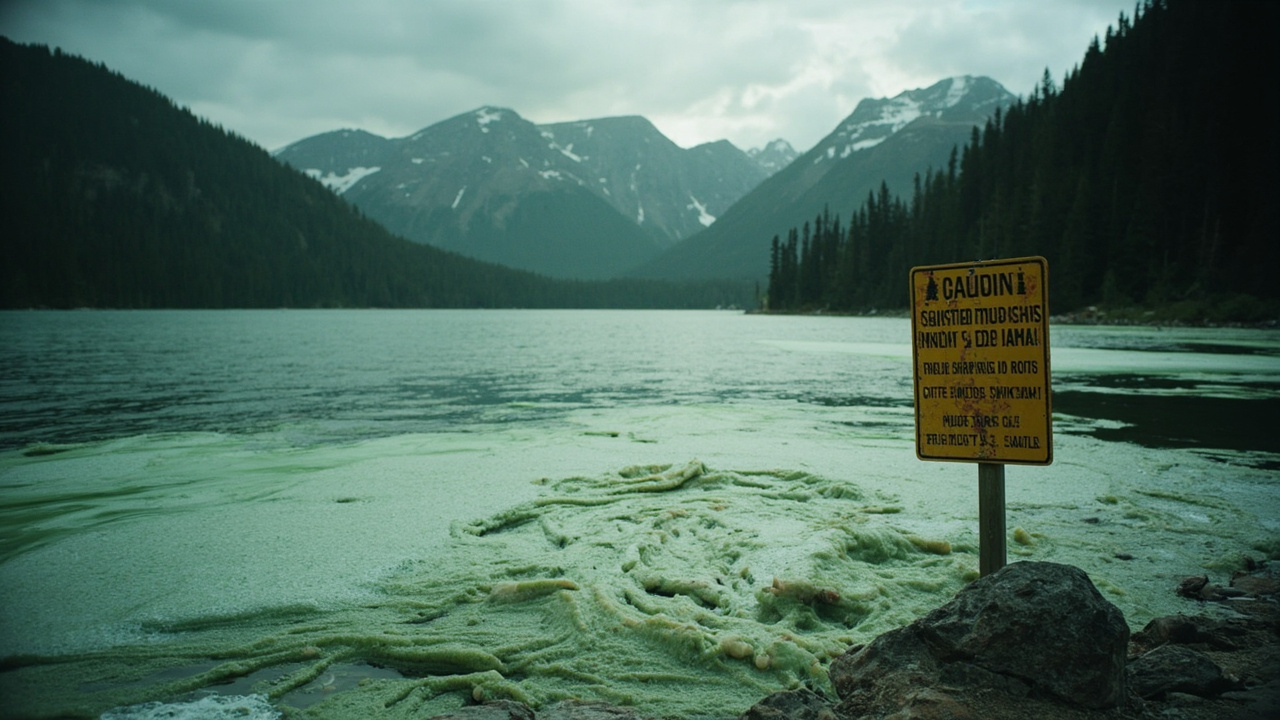
Cyanobacteria blooms do not all look alike. The Idaho Department of Health and Welfare says they may resemble mats, foam, spilled paint, or surface scum and may produce a foul odor.
Some growth sits on the bottom and remains out of sight. That hidden growth means visual inspection alone cannot guarantee safety.
The Lewiston Tribune account likewise described bloom material as sometimes resembling mats, foam, or thick soup-like water with an unpleasant smell. Travelers should treat pea-green streaks, bright-green surface films, brownish mats, floating foam, or paint-like swirls as reasons to leave the water alone.
Cooler autumn conditions do not automatically end the hazard. The Cyanobacteria Harmful Algal Blooms program says conditions supporting toxic blooms usually ease with cooler temperatures, but blooms can remain active into cooler months.
Idaho’s wider bloom picture
Mann Lake is not the only Idaho waterbody under heightened attention this fall. The state risk table also shows a health advisory for Island Park Reservoir, Sawyer’s Pond, and Ririe Reservoir, alongside alerts for Lake Lowell and Henrys Lake and watches for several other waters, according to the Cyanobacteria Harmful Algal Blooms program.
Idaho uses Health Watch and Health Alert risk levels to provide timely information while toxin testing is pending, with formal health advisories announcing confirmed toxic blooms. That tiered approach explains why some lakes carry watches based on field observations while others carry advisories based on laboratory results.
For trip planning, the lesson is to check each destination individually. A watch at one reservoir does not predict conditions at another, and an expired alert does not mean water is approved for drinking.
Reports can be submitted online through the state bloom-report form, by calling 866-671-5385, or by emailing [email protected]. People can follow the recreational-water advisory map and subscribe to email updates to learn when advisories are issued or lifted.