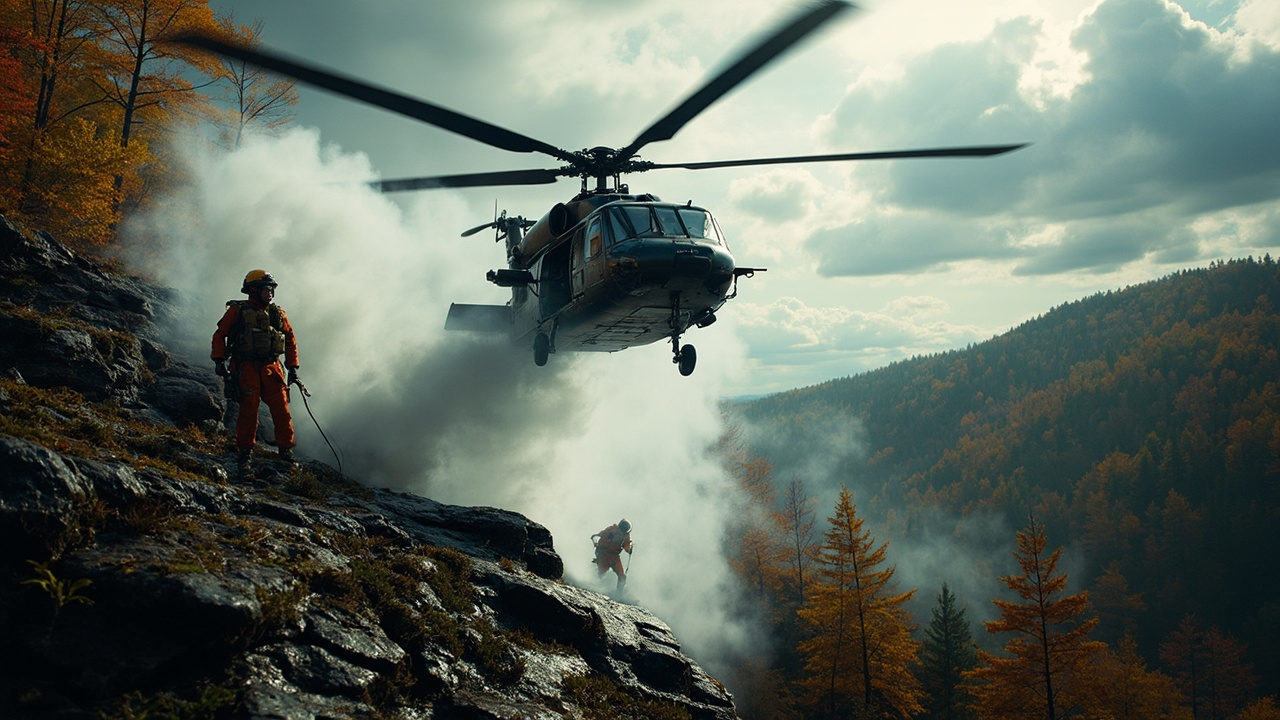
TL;DR: A Tennessee Army National Guard UH-60 crew hoisted a visitor with a severe head injury from a remote section of Alum Cave Trail on September 5, 2026, then transferred the patient to an ambulance at Joint Base McGhee-Tyson after storm weather blocked a hospital landing.
What happened on Alum Cave Trail on September 5?
A UH-60 Blackhawk crew from Knoxville's 1-230th Assault Helicopter Battalion flew to Great Smoky Mountains National Park on Saturday to recover a visitor with a severe head injury, according to radio NWTN. The report by Shannon McFarlin, posted September 8, 2026, places the pickup southeast of Gatlinburg on Alum Cave Trail. Hoodline, in a September 8, 2026 report by Michael Johnson, dates the hoist mission to September 5 and cites a Tennessee Guard statement as its basis.
Guardsmen found the patient with search and rescue personnel in a remote area of the trail, according to radio NWTN. Hoodline likewise describes the contact point as a remote section of the trail southeast of Gatlinburg. The crew worked in coordination with the National Park Service during the flight into the park, according to radio NWTN. Hoodline describes the same coordination as work with Great Smoky Mountains National Park officials throughout the mission.
The September 5 mission was at least the second dramatic park flight this year for the same battalion, according to Hoodline. On July 29, a UH-60 crew recovered a visitor thrown from a horse and used the Sugarland Visitor Center parking lot to collect the severely injured rider, as reported by the Knoxville News Sentinel and summarized by Hoodline.
How did the crew lift and move the patient?
The crew completed a medical assessment at the trail site and hoisted the patient onto the aircraft, according to radio NWTN. Hoodline reports the sequence as locating the hiker, providing first aid, and hoisting the patient into the helicopter before departure toward medical care.
Care continued in the air. The Guardsmen provided first aid while flying toward the handoff point, according to radio NWTN. That in-flight care bridged the remote trail location and the ground ambulance that would complete the hospital leg.
The aircraft involved was a UH-60 Blackhawk assigned to Knoxville's 1-230th Assault Helicopter Battalion, according to radio NWTN. Hoodline identifies the same unit as part of the Tennessee Army National Guard and places its base at Joint Base McGhee-Tyson near Knoxville.
Why did the helicopter land at the base instead of the hospital?
Severe weather prevented a direct hospital landing, according to radio NWTN. Hoodline states that a storm near the hospital made a direct landing unsafe. The account cites a Tennessee Guard statement for the diversion decision.
The crew instead flew to Joint Base McGhee-Tyson, according to radio NWTN. There, the Guardsmen transferred the patient to an awaiting ambulance for ground transport to the local hospital. Hoodline gives the same handoff location and describes an ambulance completing the transfer at the base.
The diversion shows a two-stage evacuation pattern for backcountry trauma when skies close over the destination. Air transport covered the remote-trail extraction and the flight out of the mountains, while ground transport covered the final hospital run, according to radio NWTN. Hoodline frames the storm as the reason the crew selected the base as the transfer point.
Why is this trail a repeated rescue location?
Alum Cave Trail is the route to Mount LeConte and draws emergency calls at a popular high-elevation destination, according to Hoodline. The cited trail description from Smoky Mountain Retreats puts the round trip at 11 miles with more than 2,700 feet of climbing, along narrow ledges and steep drop-offs where footing turns slick in temperate rainforest conditions.
A separate Islands.com roundup published September 6, 2026, describes Alum Cave Trail as one of the park's best-known hiking routes, with wildflowers, bridges, mountain views, and an overhanging bluff that towers 75 feet over passersby. That roundup puts the overall route at 4.6 miles round-trip and notes that length is not the central problem.
Local guide Vesna Plakanis told Outside Magazine that the trail is more slippery, exposed, and steeper than many visitors expect, as quoted in the Islands.com roundup. The same guide described the bluffs as powdery, mineral-laden sandstone that is constantly eroding. Arch Rock, a natural landmark along the way, is presented in the Islands.com roundup as a turnaround point for a more moderate and less steep hike.
The National Park Service advises that the trail can see extreme crowds during warmer months, according to the Islands.com roundup. In colder weather, ice can make slippery sections more perilous, and the same roundup notes slip-on traction devices for hiking shoes as highly recommended. The park strongly recommends staying on marked trails to avoid unstable terrain, according to the Islands.com roundup.
Past incidents underline the exposure. A 65-year-old woman died after falling from a cliff on the trail earlier in the year, with park officials confirming the death to the Knoxville News Sentinel as summarized by Hoodline. The Islands.com roundup states that a hiker fell 60 feet to her death from a cliff on Alum Cave Trail in March 2026. Archived incident reports on NPSHistory.com describe broken ankles, severe spinal injuries, other health emergencies, and deaths on the trek, according to the Islands.com roundup.
Rescue access has been a design issue on the trail. A multi-year restoration completed in November 2016 replaced narrow foot-log crossings with wider black locust wood bridges so search and rescue crews could maneuver stretchers through difficult segments, as reported by WBIR and summarized by Hoodline. The project was part of the park's Trails Forever effort balancing conservation with safer access.
Who handles the park's large rescue workload?
Great Smoky Mountains National Park is described by Hoodline as the most-visited national park in the country, with more than 11.5 million recreation visits recorded in 2025 and 2026. The Islands.com roundup similarly describes the park as the highest-volume park in the National Park System at roughly 12 million visitors per year, straddling the North Carolina-Tennessee border.
Supervisory preventative search and rescue ranger Joshua Albritton told WBIR 10News that the park averages 100 to 120 major backcountry search and rescue incidents every year, as quoted in the Islands.com roundup. The park also handles roughly 300 EMS calls in frontcountry areas such as roadways, the visitor center, and campgrounds, according to the same Islands.com summary. Hoodline cites the same annual averages from WBIR: 100 to 120 major backcountry operations plus roughly 300 frontcountry EMS calls.
March 2026 showed how calls can cluster. The park logged 38 total emergency calls that month, including 18 backcountry search and rescue missions, two National Guard Blackhawk hoist extractions, and four technical rope rescues, compared with 22 calls during the same month in 2025, according to Hoodline. The Islands.com roundup reports the same March total of 38 calls, with five resolved before teams dispatched, leaving 33 missions that included hospital transfers by helicopter, two hoist extractions, and four technical rope rescues.
The Tennessee Army National Guard is a recurring air resource. The 1-230th rescued a cold-weather-injured hiker on February 24, a medically distressed hiker near False Gap Trail on March 25, and a cardiac patient near Kuwohi Road on April 1, according to the National Guard as summarized by Hoodline. WBIR reports that the Tennessee Army National Guard typically averages four to five helicopter search and rescue evacuations in the park each year.
Ground capacity includes the nonprofit Backcountry Unit Search and Rescue, founded in 2016, whose members become temporary federal emergency employees during active calls and donate more than 4,000 volunteer hours a year, according to Hoodline. The park expanded its paid search and rescue staff from two seasonal rangers in 2020 to seven full-time positions by 2024, funded largely by revenue from the Park-It-Forward parking tag program launched in March 2023, according to Friends of the Smokies as summarized by Hoodline.
Joint training preceded the September mission. In August, the battalion completed a medical evacuation exercise in Townsend with the National Park Service Backcountry Search and Rescue team and local first responders, drilling hoist operations and rapid patient transfers in rugged terrain, according to the 134th Air Refueling Wing as summarized by Hoodline.
What should wilderness travelers take from this mission?
Check posted closures before heading out, because trails periodically close for maintenance, according to the Islands.com roundup. Alum Cave Trail is one of six formal routes to Mount LeConte, alongside Boulevard, Rainbow Falls, Trillium Gap, Bullhead, and Brushy Mountain Trails, with 42.5 miles of routes from their trailheads to the summit-top LeConte Lodge, according to the Islands.com roundup. At nearly 6,600 feet, Mount LeConte rescues can become multi-unit operations, and a 2022 illness at the lodge required both helicopter-hoist and ground teams because thick cloud cover kept the Tennessee Army National Guard medical crew from reaching the summit, according to the Islands.com roundup.
Stay on marked trails, the course the park recommends to avoid unstable ground, according to the Islands.com roundup. Consider Arch Rock as a turnaround for a shorter outing rather than continuing onto steeper, more exposed ground, according to the Islands.com roundup. Carry traction aids for footwear when ice is possible, the condition flagged as highly recommended in the Islands.com roundup. Expect company in warm months, when the National Park Service warns of extreme crowds on the trail, according to the same roundup.
The September 5 sequence reinforces why remote hikers need a margin for weather and time. Ground search and rescue personnel reached the patient first, the helicopter crew assessed and hoisted the patient, first aid continued in flight, and an ambulance finished the hospital leg after storms ruled out a direct landing, according to radio NWTN.
Sources referenced
- Tennessee Guard Blackhawk Crew Rescues Visitor To National Park | radio NWTN (https://www.radionwtn.com/2026/09/08/tennessee-guard-blackhawk-crew-rescues-visitor-to-national-park/)
- Blackhawk Crew Hoists Head-Injured Hiker Off Alum Cave Trail Near Gatlinburg - Hoodline (https://hoodline.com/2026/09/blackhawk-crew-hoists-head-injured-hiker-off-alum-cave-trail-near-gatlinburg/)