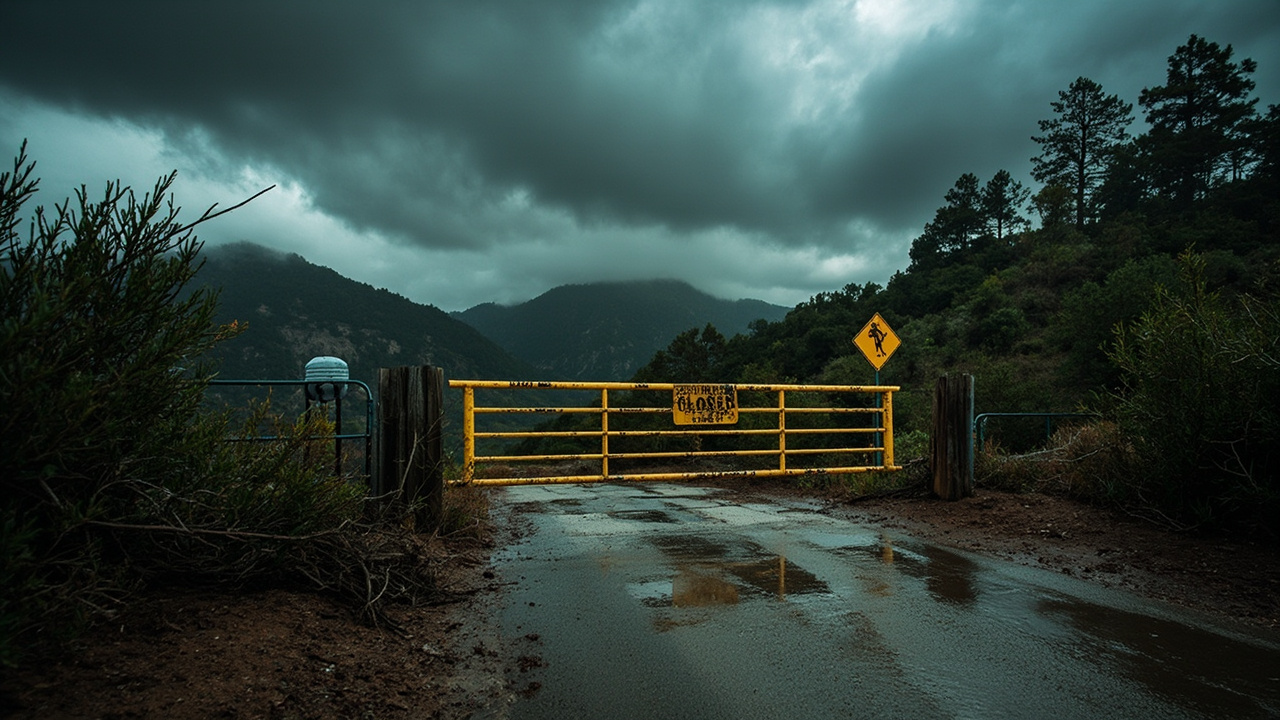
TL;DR: Claremont shut its foothill wilderness park on Sunday, Oct. 11, 2026, to keep hikers off storm-weakened trails during Tropical Storm Rachel.
Park closure answers hikers' first question
Claremont Hills Wilderness Park closed Sunday because city officials expected rain and strong winds linked to Tropical Storm Rachel, according to Claremont, CA Patch.
The city announced the shutdown on Sunday, Oct. 11, 2026. The report was posted Monday, Oct. 12, 2026, at 10:28 a.m. PT by Patch Staff writer Corey Washington.
The order covered the full wilderness park in Claremont, California, in the San Gabriel Valley foothills of Los Angeles County. Visitors were told to stay out of the area for the duration of the shutdown.
City officials gave no reopening date. The park remained closed until further notice while crews waited out the weather and later trail impacts.
The stated purpose was twofold: shield people from injury and limit harm to trails and natural resources while the storm passed.
Why trails were judged unsafe
City officials warned that rain plus wind could leave foothill paths unstable and hard to travel, according to Claremont, CA Patch.
Listed dangers included toppled trees blocking single-track routes. Flooding across low dips and creek crossings was another concern.
Slippery rock and wet wood, soft muddy tread, poor visibility in rain, and fast runoff down slopes were also named as threats to walkers and runners.
Those conditions matter in the Wilderness Park because steep foothill trails shed water quickly. Runoff can carve ruts, loosen footing, and carry branches across the path.
Fallen limbs can also hide washouts and force hikers around damaged sections, widening erosion scars in coastal sage and chaparral habitat.
The city framed the closure as preventive rather than reactive. It acted on forecast rain and gusts before damage reports accumulated inside the park.
Forecast behind the Sunday decision
The National Weather Service outlook called for intervals of rain and gusty winds starting Oct. 10, followed by a strong chance of rain Oct. 11 and more showers Monday, according to Claremont, CA Patch.
That sequence placed the park shutdown squarely in the storm window. Sunday was the day of highest expected precipitation in the local forecast.
Monday showers meant trails would not dry immediately. Saturated soil remains slick and prone to sliding after rain stops.
For wilderness readiness, the timing shows why officials close foothill access early. Waiting until trees fall or trails flood puts rescue teams and hikers at risk at the same time.
The city's message was direct: avoid the park while the closure stands. No partial access, alternate trailhead, or daylight-use exception was announced.
Where Rachel stood that weekend
Rachel reached northern Baja California on Saturday night, Oct. 10, 2026, then weakened. The National Weather Service classified it as post-tropical on Sunday, Oct. 11, according to NPR.
One assessment placed the post-tropical center about 80 miles south-southeast of San Diego late Saturday night, according to ABC News.
Even after downgrade, remnants plus a separate system over the Western United States kept pushing moisture, wind, and surf into California through Sunday and into Monday.
Forecasters said the inland push would maintain a flash-flood threat across parts of the Southwest while rough surf and gusts continued near the coast.
That evolution explains why an inland foothill park closed while headlines focused on beaches. Moisture did not stay offshore after landfall.
Coastal flooding showed storm power
Newport Beach in Orange County flooded starting Friday, Oct. 9, 2026, as swells and unusually elevated sea levels overtopped shoreline defenses, according to ABC News.
Balboa Boulevard and nearby streets filled with floodwater. Aerial images dated Oct. 9 showed people walking near floodwater amid strong waves and elevated tides.
The city declared a local emergency on Saturday, Oct. 11. Officials said the declaration would help secure extra resources to defend homes, property, and public safety.
All city beaches and piers in Newport Beach were ordered closed until further notice. Residents were urged to stay away because flooding and hazardous conditions created serious safety risks.
Oceanfront houses in Newport Beach and Long Beach were partly inundated after heavy surf broke through protective sand berms, according to NPR.
Flood warnings covered much of the California shoreline through the weekend, stretching from San Diego to the San Francisco Bay Area.
Beach and harbor towns limited access
Laguna Beach, Huntington Beach, and San Clemente handed out sandbags to residents on Sunday in anticipation of more flooding, according to ABC News.
In Seal Beach, about 30 miles south of Los Angeles, police shut beach parking lots Sunday as a precaution to protect life and property amid elevated surf and coastal flood concerns.
A coastal flood warning for Orange County beaches was scheduled to begin at 3 p.m. Sunday and run through Tuesday afternoon. Forecasters warned of major flooding and beach erosion tied in part to Rachel's remnants.
Analysts linked large Rachel-driven swells with longer-period swells boosted in part by an El Niño-enhanced Kelvin wave. The combined lift produced severe coastal flooding in Southern California.
For trail users, the coastal shutdowns carried a parallel lesson. When cities close beaches, piers, and lots, nearby wildland parks often follow because the same wind and saturated ground threaten bluff paths and canyon trails.
Inland wind, rain, and travel disruption
Outer bands from Rachel delivered gusts and downpours to parts of Southern California and Arizona on Saturday, according to ABC News.
Thunderstorms striking Menifee and Temecula, California, produced gusts above 60 mph. Those storms dropped 1 to 2 inches of heavy rain, triggering isolated flash floods and debris flows.
Gusty outflow also raised a dust storm near Phoenix, Arizona, on Saturday, cutting visibility to near zero in places.
As the center tracked inland and northeast, rockslides briefly blocked some roads, according to NPR.
Las Vegas rain broke a daily rainfall record Sunday. The National Weather Service placed much of Utah, including Salt Lake City, under a flood watch for heavy rain starting Sunday evening.
The flash-flood outlook Sunday placed a level 3 of 4 threat over parts of Southern California, northwest Arizona, southern Nevada, and southwest Utah, according to ABC News.
Forecast zones included San Diego, Indio, San Bernardino, Las Vegas, Grand Canyon-Parashant National Monument, and St. George.
State stockpiles and El Niño warning
Forecasters cautioned that Rachel might preview a harsh winter driven by what they expected to be the strongest El Niño pattern on record, according to NPR.
That pattern promised hotter-than-normal ocean temperatures with potential record rain, powerful surf, and mudslides extending into the next year.
California Gov. Gavin Newsom issued an emergency proclamation the prior month to fund protection of critical infrastructure and public preparation for severe weather.
The governor said the move would position flood-fighting supplies, reinforce water infrastructure, and help communities statewide prepare.
The state reported pre-positioning more than 4 million sandbags, more than 50,000 feet of portable flood barriers, and 400,000 tons of rock for levee repairs. Dam inspections and reinforcement of pillars supporting beach piers were also underway.
Meanwhile, Hurricane Simon churned off Mexico's Pacific Coast as a Category 4 storm, with its eye tracking parallel to shore about 60 miles offshore near Manzanillo.
What wilderness visitors should do next
The immediate instruction for Claremont remains simple: do not enter the Wilderness Park while the closure is posted, according to Claremont, CA Patch.
Hikers planning foothill trips should check city announcements before driving to the trailhead. Officials had not named a reopening day as of the Oct. 12 report.
Avoid low crossings, muddy slopes, and tree-lined trails during forecast wind and rain periods. The city specifically cited fallen trees, flooding, slippery surfaces, muddy tread, reduced visibility, and runoff as reasons to stay out.
Drivers should expect similar storm closures elsewhere. Newport Beach closed all beaches and piers until further notice, and Seal Beach closed beach lots Sunday to protect life and property, according to ABC News.
Carry flexible plans when tropical moisture reaches Southern California. The weekend showed one storm could simultaneously shut surf zones, flood boulevards, trigger desert flash-flood threats, and close inland hiking ground.
Anyone needing trail time should wait for an official all-clear, use paved neighborhood routes away from runoff channels, and keep clear of berms, flooded streets, and eroded coastal paths until warnings expire.